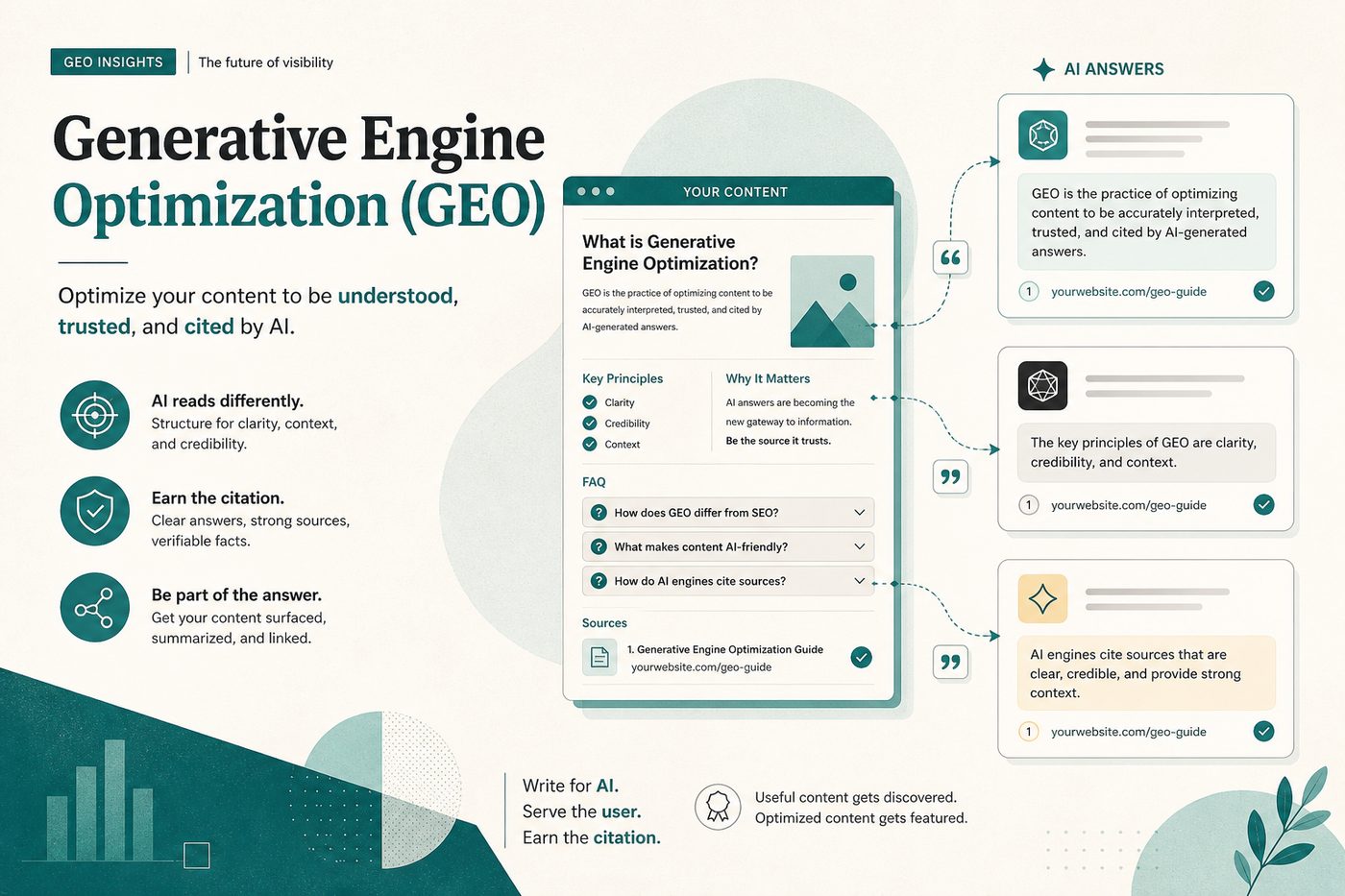
Generative Engine Optimization (GEO) is the practice of structuring your public content so AI answer engines — ChatGPT Search, Perplexity, Google AI Overviews, Claude, Copilot, and similar systems — can discover it, trust it, and cite it when people ask questions.
Classic SEO still matters: if crawlers cannot fetch you, models cannot cite you. But ranking blue links is no longer the whole game. Buyers increasingly get a synthesized answer first. If your brand is not in that answer, you are invisible in the moment of decision.
This playbook defines GEO, contrasts it with SEO, and gives an operator checklist you can apply to product pages, docs, and thought leadership — including how MCP-era tool discovery changes what “being findable” means for AI-native products.
What is Generative Engine Optimization (GEO)?
GEO (also called generative engine optimization, and sometimes grouped with answer engine optimization or AEO) optimizes for citation and inclusion in AI-generated answers, not only for traditional search ranking.
In practice, GEO means publishing content that is:
- Crawlable — AI bots and indexers can fetch the page (robots,
llms.txt, no accidental blocks) - Extractable — clear definitions, steps, tables, and FAQs that models can quote without inventing structure
- Credible — named author, dates, primary sources, consistent entity naming
- Useful under synthesis — answers the question in the first screen, then deepens with proof
Bottom line in one sentence: SEO gets you listed; GEO gets you used as the answer.
GEO vs SEO: what actually changes?
| Dimension | SEO | GEO |
|---|---|---|
| Primary win | Rank and click from a results page | Get cited or recommended inside an AI answer |
| User behavior | Scan 10 blue links | Read a synthesized answer, then maybe open 1–2 sources |
| Content shape | Keyword pages, backlinks, technical crawl health | Quotable definitions, FAQs, comparisons, how-tos, entity clarity |
| Success metric | Impressions, CTR, organic sessions | Mentions, citations, share of answer, assisted conversions |
| Failure mode | Page 2 forever | Competitors become the default recommendation in chat |
GEO does not replace SEO. It extends it. Thin, blocked, or ambiguous pages lose both games.
How AI answer engines pick sources
Implementations differ, but most generative answers follow a similar loop:
- Retrieve candidate pages (web index, partner content, licensed data, or tools)
- Rank / filter for relevance, freshness, and trust signals
- Synthesize a short answer with optional citations
- Optionally call tools — browsers, search APIs, or MCP servers — for live facts
That last step matters for product companies. If an agent can use your capability through a documented API or Model Context Protocol (MCP) server, you are not only a citation — you are an action surface. Directory visibility (for example our MCP catalog of 6,000+ servers) is becoming part of the discovery path for AI-native workflows.
The GEO content pattern that gets cited
Answer engines prefer pages that look like evidence, not slogans. Use this pattern on every high-intent page:
- Lead with the definition — one crisp paragraph that answers the query in plain language
- Name the entity — product, company, protocol, or framework, spelled the same way every time
- Add structure — H2s as questions, numbered steps, comparison tables, bullet checklists
- Show proof — dates, versions, numbers you can defend, primary links
- Close with a quotable summary — one or two sentences a model can lift cleanly
- Answer follow-ups — a short FAQ that matches how people actually ask
If your homepage only says “AI-powered platform for modern teams,” you gave the model nothing to cite. If it says what you do, for whom, with a concrete example, you gave it a sentence.
A practical GEO checklist you can ship this week
1. Unblock AI crawlers on purpose
Audit robots.txt. Many teams still block GPTBot, ClaudeBot, PerplexityBot, Google-Extended, or CCBot by copy-paste folklore. Decide deliberately:
- Allow crawlers on marketing, docs, pricing, and changelog pages you want cited
- Block private app routes, admin, account, and generated junk
- Publish an
llms.txt(and optionalllms-full.txt) that points models at your canonical docs and key URLs
2. Make one page the canonical answer
For each money query (“what is X”, “X vs Y”, “how to set up X”), pick one durable URL. Avoid three near-duplicate blog posts fighting each other. Update that URL when facts change; keep dateModified honest.
3. Write for extraction, not for keyword density
Replace vague intros with definition-first openings. Prefer:
- “X is …” in sentence one
- Steps as ordered lists
- Trade-offs in a table
- Limits and when not to use the product
Models punish fluff because fluff does not survive compression into a three-sentence answer.
4. Strengthen trust signals
- Named author with real bio (not “Marketing Team”)
- Organization schema, Article / FAQPage JSON-LD where it matches the page
- Consistent product name, domain, and social sameAs links
- Primary sources for claims — specs, changelogs, official announcements
5. Cover the question cluster, not one keyword
Map the follow-ups an AI will need after the head query. Example for MCP:
- What is MCP?
- MCP vs REST / vs RAG
- How to set up MCP in Cursor
- Security / auth pitfalls
- Where to find servers
That cluster is why guides like What is MCP?, MCP vs REST, and first Cursor setup reinforce each other — they answer the next question before the model invents it.
6. Measure citations, not only sessions
Add a weekly operating ritual:
- Run a fixed prompt set in ChatGPT, Perplexity, Google AI mode, and Claude
- Log whether you are mentioned, cited, misattributed, or absent
- Track competitor share of answer on the same prompts
- Fix the weakest page in the cluster before writing net-new content
If you only watch Google Analytics sessions, you will miss the channel where buyers now form opinions.
GEO for AI-native products and MCP servers
If your product is consumed by agents — not only by humans clicking links — GEO expands:
- Tool descriptions must be precise — agents choose tools from names and schemas, the same way answer engines choose sentences
- Setup pages must be complete — install command, auth, example prompts, failure modes
- Directory presence matters — registries and discovery servers (including Influzer MCP Discovery) are how assistants find integrations mid-conversation
- Deprecation clarity matters — outdated protocol advice gets you cited for the wrong year; see our MCP deprecation rip-out checklist
In other words: for MCP and agent tooling, your README is a GEO surface.
Common GEO mistakes
- Blocking all AI bots then wondering why competitors own the answer
- Publishing 40 thin posts instead of five definitive pages
- Hiding the answer below a hero metaphor — models and humans both bounce
- Inconsistent naming (“Influzer”, “Influzer AI”, “influzer.ai” used randomly)
- Undated evergreen claims that rot into hallucinations when versions change
- No original evidence — pure rewrites of other posts rarely become the cited source
FAQ: Generative Engine Optimization
Is GEO the same as AEO?
They overlap. GEO usually emphasizes generative engines (chat-style answer systems). AEO (answer engine optimization) is often used interchangeably. Optimize for citation in AI answers; do not get stuck on the acronym.
Does GEO kill traditional SEO?
No. Crawlability, internal links, site speed, and authoritative pages still feed retrieval. GEO changes the content shape and success metrics on top of solid SEO foundations.
How long does GEO take to work?
Technical unblocking can matter within days. Citation share usually moves over weeks as indexes refresh and you accumulate durable, well-structured pages. Treat it like an operating system, not a one-off campaign.
What content formats win most often?
Definition pages, comparisons (“X vs Y”), how-to guides with numbered steps, FAQs, and original data or checklists. Press releases and vague thought leadership underperform unless they contain extractable facts.
How do I know if AI is citing us?
Run a recurring prompt battery, watch citation links in Perplexity and Google AI Overviews, and use brand-mention / AI-visibility tools where budget allows. Pair that with referral traffic labeled as AI chat sources when analytics supports it.
GEO starter plan for the next 14 days
- Day 1–2: robots.txt +
llms.txtaudit; unblock intentional public pages - Day 3–5: rewrite your top three money queries as definition-first canonical pages
- Day 6–8: add FAQ sections and one comparison table per page
- Day 9–11: align product naming, author bios, and schema
- Day 12–14: run a 20-prompt citation test; fix the two worst absences
Further reading on Influzer.ai
- What is the Model Context Protocol (MCP)?
- Search MCP servers from Claude, ChatGPT, or Cursor
- Seven questions before you connect another MCP tool
- Browse the MCP server directory
Bottom line: Generative Engine Optimization is how you earn a place inside AI answers. Make your best pages crawlable, definition-first, structured, dated, and citable — then measure mentions the same way you once measured rankings. The brands that win GEO will not shout louder; they will be easier for machines to trust and quote.
One clear email each Thursday
Actionable frameworks on AI execution, agents, and MCP. Join 4,200+ builders.
Leave a comment
Be the first to share your thoughts.