If you have shipped production software in the last decade, you already know REST. You have read OpenAPI specs, fought pagination quirks, wrapped OAuth flows, and written retry logic that only your team understands. REST is excellent at what it was built for: predictable, resource-oriented communication between applications you control.
Then AI agents entered the workflow — and the integration problem changed shape. Your agent does not need a CRUD map of every endpoint. It needs to answer a different question: “What can I do right now, with this credential, in this environment?”
Model Context Protocol (MCP) servers answer that question directly. They expose a standardized tool surface — discoverable actions with names, descriptions, and input schemas — that LLM clients can call without bespoke SDK code for every service.
REST is not going away. But for AI-native development, MCP is becoming the integration layer developers should learn first. Here is why that matters, how the two models differ, and when to reach for each.
Two protocols, two different jobs
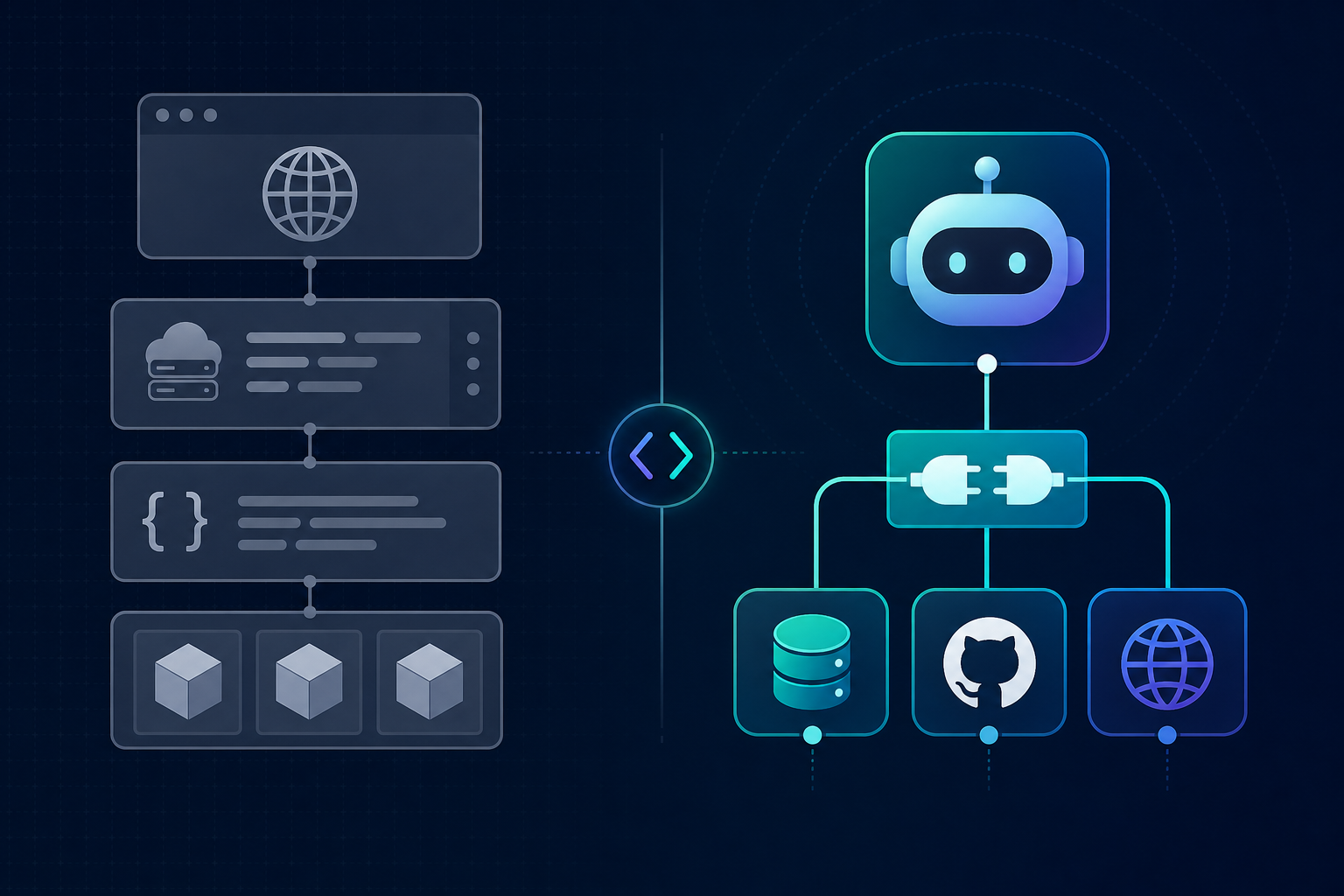
Think of REST as the plumbing between services. Think of MCP as the control panel for agents.
- REST describes resources (users, orders, repos) and HTTP verbs on fixed URLs. Your application code decides which endpoints to call and when.
- MCP describes tools — callable capabilities with human-readable intent (“search issues”, “run query”, “scrape URL”). The agent client discovers tools dynamically via
tools/listand invokes them through one protocol.
That distinction sounds subtle until you wire an agent to five external systems. With REST, you embed five integration stories in your orchestration code. With MCP, you attach five servers and let the client speak one language.
MCP vs REST at a glance
| Dimension | REST APIs | MCP servers |
|---|---|---|
| Primary consumer | Your application code | AI clients and agents (Cursor, Claude Desktop, custom backends) |
| Discovery | OpenAPI/Swagger docs — static, developer-read | tools/list — dynamic, machine-readable at runtime |
| Unit of work | HTTP request to resource endpoint | Named tool with schema (intent-first) |
| Integration style | Per-service SDK or custom HTTP client | One MCP client + pluggable servers |
| Auth model | Per-API keys, OAuth, IAM — you implement each | Delegated to server config (env vars, tokens in client settings) |
| Best for | Deterministic app logic, high-throughput backends, public product APIs | Agent workflows, IDE extensions, composable tool stacks |
| Swap cost | High — changing vendors touches application code | Lower — change server config, keep agent logic stable |
REST optimizes for contracts between engineering teams. MCP optimizes for capabilities an agent can reason about. Both can coexist in the same product — and increasingly do.
Why REST falls short for AI agents (even when the API is great)
This is not a knock on REST. GitHub’s REST API is mature. Stripe’s is a masterpiece. The problem is the agent integration boundary, not API quality.
1. Agents need intent, not endpoint maps
When a developer calls GET /repos/{owner}/{repo}/issues, they already know the goal. An agent must infer the goal from natural language, then map it to the correct endpoint, parameters, and pagination strategy. Every REST surface becomes prompt engineering plus custom glue code.
MCP flips the interface: the server advertises search_issues with a description and input schema. The model picks a tool by capability, not by reading 400 lines of API reference.
2. Heterogeneous error shapes slow agents down
One API returns { "error": { "code": ... } }. Another returns plain text. A third uses HTTP 422 with a different schema. Your agent orchestration layer ends up as an error normalization project — before you ship a single feature.
MCP does not eliminate errors, but it standardizes the invocation envelope. Tool results flow back through one protocol, which makes retries, logging, and guardrails consistent across services.
3. SDK sprawl becomes agent sprawl
A typical agent stack might touch GitHub, Postgres, Slack, a browser, and a vector store. In REST-land that is five clients, five auth flows, five rate-limit policies, and five places to patch when something breaks.
With MCP, each capability domain is a server. Your agent client loads a tool list from each and moves on. Browse the Top 100 MCP servers and you will see how far the long tail already reaches — databases, browsers, SaaS products, cloud providers, and niche dev tools.
4. Documentation is written for humans, not runtime discovery
OpenAPI is valuable — but it is still a spec document. Agents need runtime discovery: what is enabled in this deployment, with these credentials, on this machine?
tools/list answers that question every session. Directories like Influzer.ai’s full MCP catalog index those tools so developers can search by what a server does, not only by vendor name.
What developers gain with MCP (that REST alone does not provide)
Faster path from idea to working agent
Connecting a hosted Postgres MCP server or the official GitHub server takes minutes in Cursor or Claude Desktop. The equivalent REST path means auth setup, client construction, response parsing, and writing agent-specific wrappers. Teams routinely trade days of integration work for a config block.
Composable toolchains without rewrites
Need scraping plus SQL plus ticketing? Attach three MCP servers. Swap one vendor? Update config, not your orchestrator’s core code. Composability is the developer superpower — integrations behave like modules.
One mental model for local and remote
MCP supports stdio (local process on your laptop) and HTTP (remote hosted endpoint). The same tool abstraction applies whether you are running a filesystem server locally or hitting a vendor’s cloud MCP URL. That uniformity reduces operational surprise when you move from dev to shared team environments.
Community-maintained capability layers
Popular servers — Playwright, Context7, Firecrawl, Slack, AWS — are maintained by vendors or active open-source communities. You inherit new tools and fixes without patching your app’s integration layer. As the registry grows past 1,500 listings, the odds improve that someone already built the server you need.
Governable boundaries for engineering leads
Teams can standardize on an approved MCP config: which servers are allowed, which tools are in scope, which credentials are used. That is easier to audit than a folder of one-off REST scripts copied between projects.
When REST is still the right choice
Pragmatic developers do not replace REST — they stop forcing agents to speak REST directly.
Stay with REST (or gRPC) when:
- You own both sides of the contract — microservices talking to microservices with strict SLAs
- Throughput and latency are paramount — high-QPS paths where every millisecond and byte matters
- Behavior must be fully deterministic — financial transactions, inventory commits, idempotent workflows with hard invariants
- You are exposing a public product API — third-party developers expect REST/OpenAPI, not MCP
- The consumer is not an LLM client — mobile apps, web frontends, partner integrations
MCP is not a replacement for your core API surface. It is an adapter layer that makes external capabilities agent-ready.
When MCP should be your default
Reach for MCP first when:
- An AI client needs external capabilities — IDE agents, desktop assistants, internal copilots
- You are prototyping agent workflows — speed matters more than bespoke optimization
- You want hot-swappable tools — experiments with different scrapers, databases, or ticket systems
- Multiple agents share the same capabilities — one server, many clients
- You are wrapping internal APIs for agent access — even proprietary systems benefit from a standard tool surface
If you are building agent features in 2026, starting with MCP is usually faster than embedding REST clients in prompt logic — then optimizing hot paths later.
The practical pattern: REST inside, MCP outside
Most serious MCP servers are thin, opinionated wrappers around REST (or vendor SDKs). The GitHub MCP server speaks GitHub’s APIs. A Postgres MCP server speaks SQL. Firecrawl wraps its own HTTP product.
That means you do not have to choose one religion. The winning architecture looks like this:
- Keep REST for your product’s public API and service-to-service traffic
- Publish MCP when you want agents (yours or customers’) to use your product safely
- Consume MCP when you want agents to use other people’s products without custom glue
If you maintain a service agents should use, shipping an MCP server is becoming as important as shipping an SDK was five years ago.
What this looks like in a developer workflow
Three places MCP is showing up today:
- IDE agents (Cursor, Windsurf): extend the agent beyond the repo — query staging databases, inspect Sentry, open Linear issues
- Desktop assistants (Claude, etc.): personal stacks combining calendar, notes, browser, and dev tools through one interface
- Custom agent backends: your orchestration layer calls MCP tools instead of maintaining dozens of REST clients
The loop is the same everywhere: pick a server, configure transport, verify tools/list, wire policies to the tools you trust. For a deeper walkthrough of how MCP is reshaping integration strategy, see MCP Servers Are Taking Over the Integration Game.
Evaluating MCP servers without betting a sprint
Not every server in a directory is production-grade. Before you depend on one:
- Inspect the tool list — are tools granular and purposeful, or a thin pass-through?
- Check transport — stdio vs HTTPS; which fits your security model?
- Read setup docs — auth, env vars, and example client config
- Smoke-test a read-only tool — confirm latency, errors, and output shape
- Pin versions — treat server updates like dependency upgrades
Start from the curated Top 100 for proven options. Search the full directory for niche tools. If you maintain a server we are missing, submit it — the catalog syncs weekly from registries and tool lists are re-validated daily.
Common developer objections (answered honestly)
“Isn’t MCP just JSON-RPC with marketing?”
Parts of it rhyme with older RPC patterns. The value is not novelty — it is standardization at the agent boundary. One discovery format, one client ecosystem, shared conventions across vendors. That consolidation is what developers feel in reduced glue code.
“We already have OpenAPI — isn’t that enough?”
OpenAPI is excellent for codegen and human docs. Agents still need runtime tool selection, consistent invocation semantics, and client support in IDEs. MCP packages those for LLM workflows in a way OpenAPI alone was never aimed at.
“Auth does not get simpler.”
Correct. OAuth is still OAuth. MCP moves credential configuration to the server and client settings, but you still own scopes, rotation, and least privilege. Do not confuse protocol convenience with security responsibility.
“What about validation — agents hallucinate tool args.”
Tool schemas help, but they do not guarantee correct reasoning. You still need output validation and human review on high-stakes paths. See why AI output validation requires human engineers.
Why developers should care now, not after the ecosystem matures
Integration technologies look like fads until the moment switching costs flip. MCP is crossing that line because agent clients are shipping MCP support by default — and the catalog of servers is large enough that building everything yourself is already the slower path.
Developers who learn MCP early get compound returns:
- Less time rebuilding the same REST wrappers for every new agent experiment
- Faster onboarding when joining teams that standardize on shared MCP configs
- Better leverage from vendor-maintained servers as more SaaS products ship first-party MCP endpoints
- A credible path for exposing your own product to the agent ecosystem
REST will remain the backbone of the web. SDKs will not vanish. But the default answer to “how does my agent do something in an external system?” is rapidly becoming “connect an MCP server.”
Quick answers
Should new agent projects skip REST entirely?
No. Use REST for your core services and public APIs. Use MCP at the agent boundary — consuming external capabilities and exposing your own.
Can I wrap our internal REST API as MCP?
Yes — and you probably should if agents are a target consumer. Define intentional tools, not one-to-one endpoint mirrors.
Cursor vs Claude Desktop — same servers?
Mostly yes. Config format differs slightly; the servers are shared.
How do I debug tool calls?
Confirm tools/list first. Log inputs and outputs at the client. Treat failures like API errors — check auth, schema, and rate limits before blaming the model.
Final thought
REST taught a generation of developers how to build reliable service contracts. MCP teaches the next layer: how to make capabilities discoverable and callable by machines that reason in natural language.
If you are still hand-wiring every REST client into every agent experiment, you are paying a tax that the ecosystem has already started to eliminate. Browse the Top 100 MCP servers, wire up the tools your next project needs, and spend the time you save on problems only your code can solve.
One clear email each Thursday
Actionable frameworks on AI execution, agents, and MCP. Join 4,200+ builders.
Leave a comment
Be the first to share your thoughts.