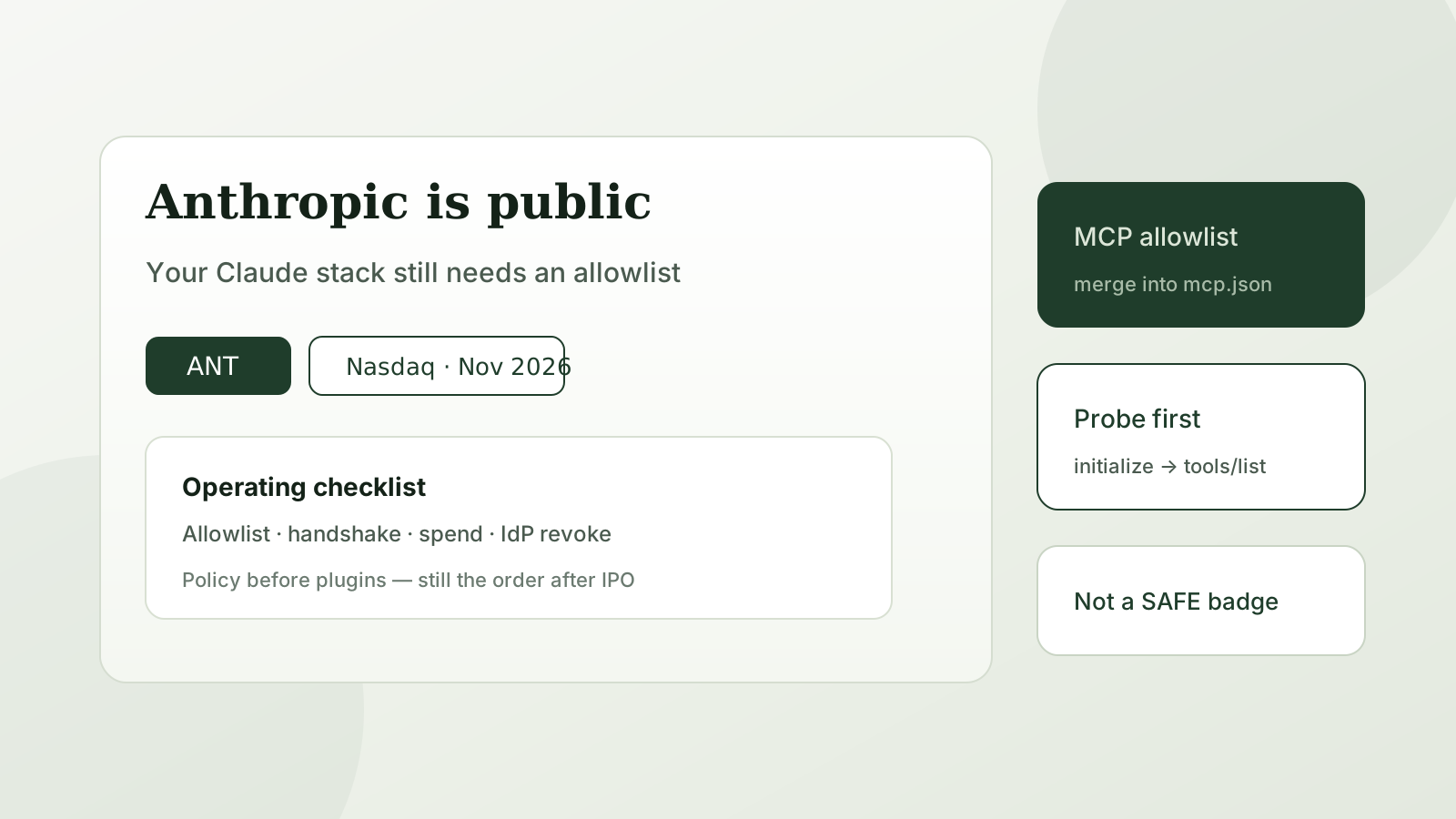
Anthropic closed its initial public offering on 20 November 2026. Class A shares priced at $83, began trading on Nasdaq as ANT on 19 November, and the company reported roughly $91.6 billion of IPO proceeds to Anthropic (about $93.5 billion gross including selling stockholders), plus a concurrent ~$26 billion Class N private placement to a chip-and-cloud consortium. Combined gross proceeds were about $119.5 billion before fees — per Anthropic’s own closing note.
That is historic market structure. It is not, by itself, an operating plan for your company.
If you run Claude Desktop, Claude Code, ChatGPT connectors, or Cursor with MCP servers, the useful question this week is narrower:
Would your agent tool access survive the same diligence posture you now expect from a public AI vendor?
Most stacks would not. An IPO changes the vendor’s capital structure. It does not install your allowlist, IdP mapping, or spend controls.
What actually changed (and what did not)
Changed: Anthropic is now a public company (and remains a public benefit corporation). Reporting, scrutiny, and capital-market narratives will get louder. Compute partners writing large Class N checks (AMD, Broadcom, Google, Micron, Microsoft, NVIDIA, TSMC) underline how tightly model companies and infrastructure are wired together.
Unchanged for you on Monday:
- Your team can still attach unmanaged MCP servers on Friday afternoon
- Personal OAuth and PATs in shared configs still look like incident reports waiting to happen
- “We use Claude” is still not the same as “we know which tools Claude can call”
- Handshake facts still beat star counts — and still are not a SAFE badge
Public markets price the model company. Your risk lives one layer down: tools.
Why IPO week is a governance week
Big AI financings create a predictable internal reaction: more experiments, more “just connect this,” more budget for agents. That is fine — if the on-ramp is controlled.
Map the moment onto the same control planes we already argued in tool access as an operating control:
- Allowlist — what may connect
- Identity — who the agent acts as
- Evidence — what you can reconstruct after a bad write
IPO headlines make executives pay attention for about two meetings. Use that attention. Do not spend it debating valuation multiples.
A 60-minute Claude / MCP hygiene pass
Steal this agenda. No working group required.
1) Inventory the real config (15 min)
List every place agents already have tools: project .cursor/mcp.json, Claude connectors, ChatGPT custom connectors, Slack tools. Mark each read / write / unknown. Unknown counts as write.
2) Publish a one-page allowlist (15 min)
Default deny for writes. Separate local/stdio from remote/HTTPS. Name an owner. If you need the sequencing argument, reread policy before plugins — then export a concrete pack from the MCP allowlist / policy pack and merge into Cursor instead of hand-picking remotes.
3) Probe before you trust (15 min)
For every remote HTTPS candidate, run a handshake (initialize → tools/list) before it enters shared config. Start at /mcp/probe or the listing probe badge. Live answering is not safety approval — it is the minimum observable fact.
4) Cap spend and revoke paths (15 min)
Name who owns model spend this quarter. If you are still guessing which model is “cheap enough,” put a router in front of vanity defaults — see ModelSpend. Confirm IdP offboarding kills connectors; paste-a-key does not.
Builders: ship recipes, not mystery installs
IPO week will spawn a fresh wave of “connect Claude to X” tutorials. Prefer recipes that show config + prompt + language starters over gist-driven npx roulette.
On Influzer we published starter recipes for that reason — including Stripe PaymentIntent snippets in Node, Python, and PHP, plus GitLab / Redis / DevTools / Datadog+Sentry workflows. Browse /recipes. Still not verified-by-default. Still not a substitute for your allowlist.
What leaders should say out loud
- “Claude is approved. Unmanaged MCP is not.”
- “Search with Discovery. Install only from the allowlist.”
- “Write tools need a named owner — demos do not grant Class C/D access.”
- “We will reconstruct a tool call in 15 minutes in next month’s risk review.”
That is the adult version of celebrating ANT.
Quick answers
Does Anthropic going public change Claude’s product terms overnight?
Not by ticker magic. Watch Anthropic’s published product, security, and commercial docs the same way you watch any strategic vendor — on a cadence, with an owner.
Should we freeze new MCP servers this week?
Freeze unmanaged adds. Keep a path for approved remotes and read-only Discovery so teams do not invent shadow configs.
Is an allowlist export “security approved”?
No. Influzer’s pack is filtered handshake / catalog facts for Top 100 remotes. It is a starting policy artifact — not a SAFE badge. Review auth, tools, and blast radius yourself.
Where should engineering start on Monday?
Export the pack at /mcp/allowlist, probe anything new, put Discovery on the allowlist as Class A search, and open a PR that updates shared mcp.json with a reviewer — not a DM.
Related reading
- Policy before plugins — write the MCP allowlist first
- AI agent tool access as an operating control
- Verify an MCP server before you connect
.cursor/mcp.jsonis becoming team policy- ModelSpend — cheapest suitable model routing
Final thought
Anthropic’s IPO is a capital-markets event. Your Claude stack is an operating system for delegated work.
Do not confuse the two.
Celebrate the milestone if you want. Then spend an hour on the boring controls: allowlist, handshake, identity, spend, revoke. That is how public-company AI vendors expect their customers to behave — and how you avoid learning MCP governance in a postmortem.
Start here: export an allowlist pack · probe a remote · browse recipes · add Discovery.
One clear email each Thursday
Actionable frameworks on AI execution, agents, and MCP.
Leave a comment
Be the first to share your thoughts.