Most companies still govern AI like content risk: what the model might say. That was incomplete even for chat. It is dangerously incomplete for agents that can act.
Once Claude, ChatGPT, or Cursor can call tools — create tickets, query databases, scrape customer data, push code, refund invoices — the binding constraint is not prompt quality. It is which tools the agent is allowed to touch, under whose identity, with what audit trail if something goes wrong.
That is not a developer preference. It is an operating control — the same class of control as bank signing authority, production deploy rights, and vendor access reviews. If you already built an AI decision liability posture, tool access is the missing half: liability asks who owns the decision; tool access asks what the agent was empowered to do in the first place.
The shift: from chatbots to delegated authority
A chatbot answers. An agent delegates.
When a user connects an MCP server — or an admin provisions a connector through the IdP — the company has granted a capability bundle to a non-human caller. The user thinks: “I connected Linear.” The operating reality: “We installed a persistent actor with some subset of Linear’s privileges.”
That actor:
- May call tools repeatedly, overnight, or in a Slack thread
- May chain a read into a write faster than a human reviewer can intervene
- May inherit tokens that outlive the employee who clicked Allow
- May run on someone else’s cloud (ChatGPT / Claude connectors) where localhost and “just my laptop” no longer apply
If your governance still starts at “review the output,” you are governing the last mile while leaving the on-ramp wide open.
Map tool access onto decision classes
Reuse the risk classes from liability governance — then attach tool tiers to each:
| Decision class | Typical agent tools | Minimum access control |
|---|---|---|
| A — Informational | Docs search, Discovery MCP, read-only knowledge | Allowlist; no secrets in prompts |
| B — Operational assist | Ticket search, CRM lookup, log query | IdP group scope; read-mostly tools |
| C — Decision-influencing | Create issue, draft PR, update opportunity | Named owner; write tools gated; human confirm for high impact |
| D — Rights / regulated / money | Refunds, access grants, HR actions, production mutate | Default deny; dual control; full audit; often no agent write |
Most incidents happen when a Class C/D capability is installed under a Class A mental model: “it’s just a helpful coding assistant.”
The three control planes executives must own
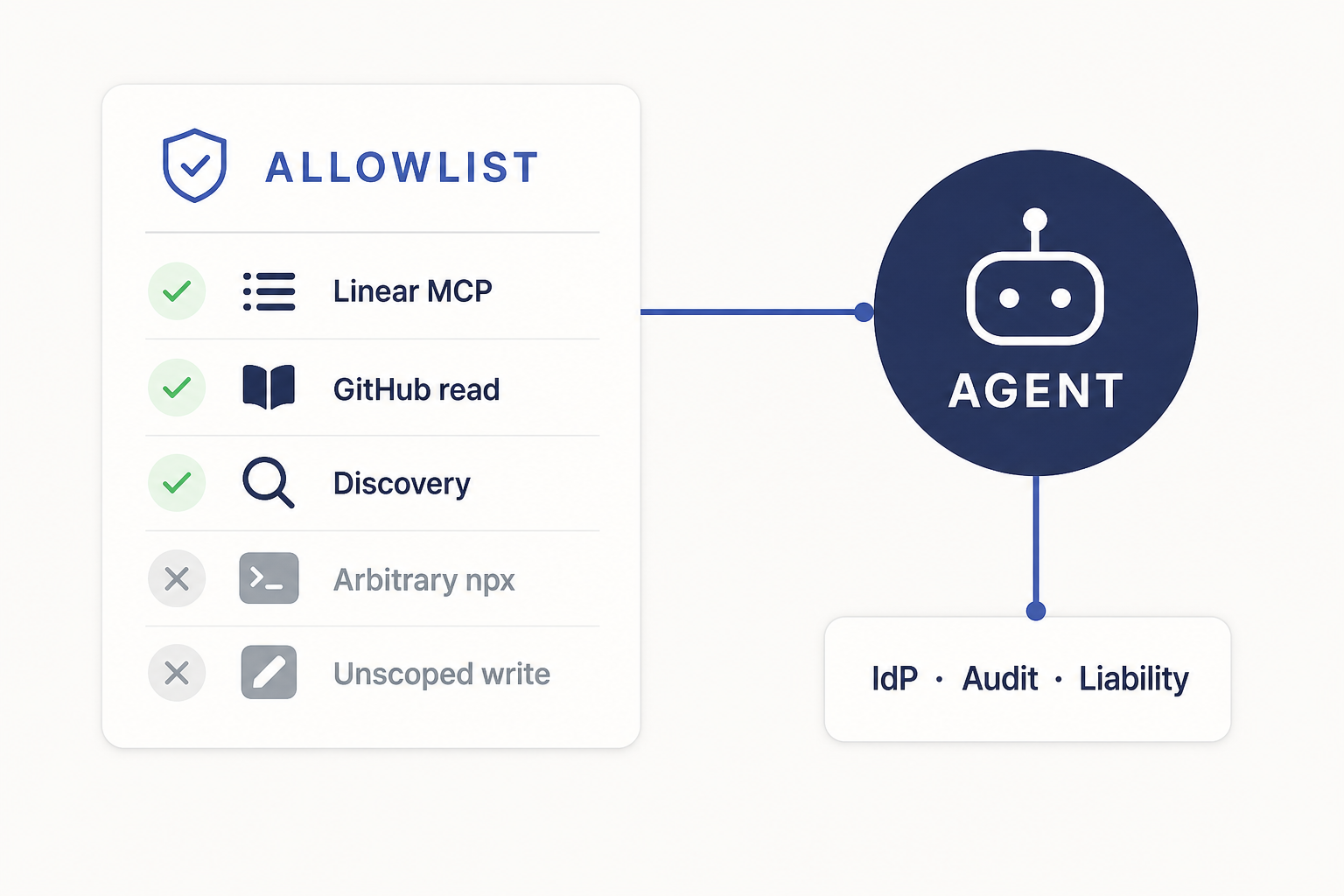
1) Allowlist — what may be connected
Stop treating MCP configs as personal taste. Publish an approved server list the way you publish approved SaaS:
- Named servers (and versions / endpoints) only
- Explicit ban on arbitrary
npx/ unknown GitHub URLs in team configs - Separate lists for local/stdio (developer machines) vs remote/HTTPS (chat connectors)
- Re-review when a server adds write tools or expands scopes
Directories help buyers compare — start with the Influzer Top 100 and treat “tools indexed” as a stronger signal than stars. Require teams to run something like the seven-question MCP server audit before production use.
2) Identity — who the agent acts as
Paste-a-key and personal PATs in shared .cursor/mcp.json files are not an access model. They are a future incident report.
Prefer:
- Enterprise-managed connector auth through your IdP (Okta and peers) so provision and revoke follow employment — see enterprise-managed MCP auth
- Group-scoped connectors — engineering gets GitHub + Linear; finance does not
- Short-lived tokens and no long-lived personal credentials in repos
- Service accounts only where a human identity is wrong — with owners and rotation
If the client still requires individual OAuth, treat that as a temporary path with documented revocation — not the end state. Builders who over-scope tokens create your liability; push them toward the patterns in OAuth and the over-permission trap.
3) Liability — what you can prove after the fact
When an agent creates a wrong refund, leaks a customer list, or opens a public repo to the wrong people, investigators will ask the same questions as any AI-influenced decision — plus one new one:
- Which tools were enabled for this user / group at the time?
- Which tool calls ran (name, args summary, timestamp)?
- Under which identity / token?
- Who approved the allowlist entry?
- Was human review required for that class of write?
If you cannot reconstruct that chain, you do not have an operating control. You have a hope.
Remote vs local is a governance fork
Local stdio MCP (Cursor on a laptop) and remote HTTPS MCP (Claude / ChatGPT connectors) are not the same risk surface:
- Local: secrets may stay on device; shadow IT via personal configs; hard to inventory
- Remote: traffic leaves your perimeter; must be public HTTPS; IdP-managed auth becomes feasible; localhost will not work
Executives should publish two policies, not one. “MCP is allowed” without specifying lane is how finance connectors appear in a personal ChatGPT project.
For a short primer on the split, see our brief: Remote vs local is the real MCP split now. For a remote, read-only discovery path you can attach without shipping secrets, use Influzer MCP Discovery.
An operating cadence that fits leadership rhythm
Do not invent a new committee if you already run AI risk reviews. Extend them:
- Weekly (ops / platform): new connector requests, denied installs, tool-call error spikes, near-miss writes
- Monthly (security + eng leadership): allowlist diffs, IdP group coverage, servers that gained write tools, offboarding exceptions
- Quarterly (exec / risk): Class C/D agent workflows inventory, liability evidence drill (“reconstruct this action in 15 minutes”), vendor MCP auth maturity
- On change: IdP migration, new chat client (ChatGPT Developer Mode, Claude Enterprise), MCP spec / auth model changes
Tie this to the same weekly / monthly / quarterly cadence in the liability playbook so tool access and decision quality are reviewed together.
Metrics that prove control is real
- Allowlist coverage: percent of agent sessions using only approved servers
- IdP-backed share: percent of production connectors provisioned via IdP vs personal OAuth / PAT
- Write-tool exposure: count of Class C/D write tools enabled org-wide
- Time-to-revoke: median time from IdP offboard to dead connector access
- Time-to-explain: median time to reconstruct a specific agent tool action
- Shadow config rate: repos or laptops with unapproved MCP entries (sampled)
Vanity metrics (number of connectors enabled, number of agent messages) hide risk. These metrics expose it.
90-day plan for the executive sponsor
- Days 1–15: Inventory where agents already have tools (Cursor configs, Claude connectors, ChatGPT custom connectors, Slack Claude Tag). Classify each by decision class A–D.
- Days 16–30: Publish v1 allowlist + explicit bans. Assign owners: business owner per Class C/D workflow, platform owner for connector plumbing, security owner for IdP mapping.
- Days 31–45: Move high-traffic connectors onto IdP-managed auth where available. Kill shared PATs in git.
- Days 46–60: Split read vs write: disable or dual-control Class D writes; require human confirm for material Class C writes.
- Days 61–75: Run an evidence drill — pick a real tool call and reconstruct identity, allowlist entry, and outcome. Fix logging gaps.
- Days 76–90: Board / ELT one-pager: agent tool access as an operating control, metrics baseline, open exceptions.
Common executive mistakes
- Delegating “MCP policy” only to engineering: engineers optimize for velocity; you own liability and customer trust
- Equating SSO to the chat app with tool governance: users can still attach unmanaged servers
- Allowing write tools because the demo was impressive: demos are Class A theater; production is Class C/D
- Ignoring local configs because “IT manages Claude Enterprise”: Cursor on laptops is often where the widest tools live
- Assuming vendor MCP quality equals vendor brand: evaluate tool surface and scopes — see the audit checklist
How this links your existing playbooks
- Liability playbook — who owns the decision and how you prove controls → AI Decision Liability and Compliance
- Enterprise auth — how rollout and revoke work at org scale → Enterprise-Managed MCP Auth
- Builder permission design — why servers over-permission agents → OAuth and the Over-Permission Trap
- Consumer diligence — what to ask before connecting → Seven-Question Server Audit
- Validation — governed tools still need human judgment on outputs → Why AI Output Validation Requires Human Engineers
Quick answers leaders ask
Can we ban MCP until we are ready?
You can ban unmanaged MCP. A total ban usually drives shadow configs. Prefer: approved list + IdP path + default-deny writes.
Is enterprise-managed auth enough?
It solves provision and revoke. It does not decide which tools are safe, whether writes need human confirm, or whether logs exist. Auth is plane two of three.
Who should own the allowlist?
Platform or IT security maintains the list; business owners approve Class C/D entries for their workflows; an executive sponsor resolves trade-offs when velocity and risk conflict.
Where do we start if we only have Cursor today?
Inventory project-level mcp.json files, ban PATs in git, allowlist three read-mostly servers, and document the remote path before anyone enables ChatGPT or Claude org connectors.
Does a read-only discovery server belong on the allowlist?
Usually yes — Class A. A public read-only directory searcher (like Influzer MCP Discovery) helps agents find approved options without granting write power.
Final thought
AI agents are becoming a new kind of employee: fast, tireless, and only as constrained as the tools you hand them.
Prompt guidelines are not enough. Model vendor terms are not enough. Even “we use Okta” is not enough if every developer can still attach an unscoped write server on Friday afternoon.
Treat tool access as an operating control: allowlist what may connect, identity who it acts as, and evidence what it did. Pair that with your liability classes and you get a governance system that scales with agents — instead of a postmortem that starts with “we didn’t know that connector was enabled.”
Browse candidates for your allowlist in the MCP directory. Prefer IdP-ready connectors where your stack supports them. And keep decision ownership human — especially when the agent can write.
One clear email each Thursday
Actionable frameworks on AI execution, agents, and MCP. Join 4,200+ builders.
Leave a comment
Be the first to share your thoughts.