AI systems are now shaping real business outcomes: which customers get prioritized, which invoices are flagged, which hires move forward, which contracts get escalated, and which risks receive immediate attention. In many companies, these systems already influence decisions faster than formal governance has evolved.
That creates a core executive problem: when AI contributes to a bad decision, who is accountable, and how do you prove that reasonable controls were in place?
This is no longer a theoretical legal question. It is an operating question that affects board risk, enterprise value, customer trust, and regulatory exposure.
Start with a hard truth: liability does not transfer to the model
Even when a third-party AI provider is involved, your company remains accountable for how AI outputs are used in your own decisions. Courts, regulators, customers, and auditors will evaluate your controls, your supervision, your documentation, and your escalation practices - not the vendor marketing page.
In plain terms: if AI influences decisions in your business, governance of those decisions is your responsibility.
Where AI liability risk shows up first
Most companies face risk before they realize they have an AI system. Risk often appears in ordinary workflows where AI is embedded quietly:
- Revenue operations: lead scoring, discount recommendations, churn flags, territory prioritization
- Finance: anomaly detection, forecasting assumptions, expense approvals, fraud alerts
- People operations: resume screening, candidate ranking, performance signal aggregation
- Support and trust: case triage, policy interpretation, automated response suggestions
- Procurement and legal: clause extraction, contract risk scoring, renewal recommendations
- Security and risk: incident triage, threat prioritization, suspicious-activity pattern flags
Each of these can produce speed and value. Each can also produce unfair, incorrect, or non-compliant outcomes if controls are weak.
The accountability model executives should implement
One of the biggest gaps in AI programs is ambiguous ownership. A practical accountability model assigns roles clearly:
- Business owner (decision owner): accountable for outcome quality and decision appropriateness in a specific workflow.
- Model or system owner: accountable for AI pipeline reliability, data dependencies, and change controls.
- Control owner: accountable for validation checkpoints, monitoring thresholds, and exception handling.
- Risk and compliance owner: accountable for legal mapping, policy alignment, and escalation triggers.
- Executive sponsor: accountable for cross-functional trade-offs and resource decisions when risk is material.
If one person cannot be named for each role, governance is incomplete.
Decision classes: not all AI use cases need the same control intensity
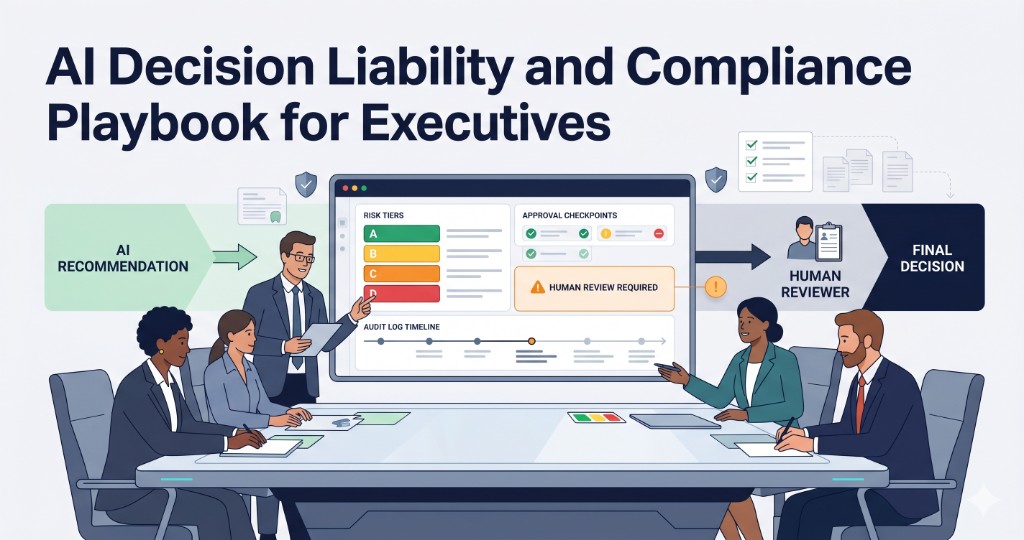
A common failure mode is applying either too little control everywhere or heavy control everywhere. Both fail. Use risk-tiered classes:
Class A: informational support
Examples: internal summaries, brainstorming, draft messaging. Control: lightweight review and source awareness.
Class B: operational assistance
Examples: queue prioritization, case routing, standard reporting. Control: periodic sampling, reconciliation, and incident logging.
Class C: decision-influencing
Examples: pricing decisions, staffing prioritization, financial exceptions, contract acceptance. Control: mandatory human review and documented rationale.
Class D: rights-impacting or regulated
Examples: employment eligibility, credit-like decisions, safety or legal exposure decisions. Control: strict review, evidence trail, dual approvals, and legal oversight.
Most liability events happen when a Class C/D workflow is mistakenly treated like Class A/B.
What regulators and auditors typically look for
Across jurisdictions and sectors, review bodies tend to ask similar questions:
- Was AI involvement disclosed where required?
- Can you explain how a decision was made at the time it was made?
- Did a qualified human review high-impact outputs before action?
- Were known limitations and bias risks documented and monitored?
- Did you retain logs, inputs, version history, and overrides?
- Were exceptions escalated quickly and handled consistently?
- Did customers or employees have a path to contest outcomes?
If your team cannot answer these quickly with evidence, legal exposure increases even before any penalty occurs.
The seven control pillars of an AI liability-safe operating model
1) Decision inventory and risk mapping
Maintain a live inventory of where AI is used, what decision it influences, and what harm can occur if wrong. Tag each workflow by risk class and control requirements.
2) Policy-to-workflow translation
Company policy is not enough unless translated into step-level workflow rules. Example: human review required should map to a specific approval checkpoint and required artifact.
3) Data and semantic controls
Many liability issues are semantic, not technical. Define authoritative business terms (for example, booked revenue vs recognized revenue) and require AI workflows to use those definitions explicitly.
4) Human validation and override design
Design clear review screens, override paths, and rationale fields so humans can challenge AI recommendations quickly. A human-in-the-loop control that is cumbersome will be bypassed.
5) Monitoring, drift, and threshold alerts
Track error rates, override rates, and outcome disparities over time. Trigger escalation when thresholds are breached. Monitoring must be active, not quarterly theater.
6) Auditability and evidence retention
Keep logs of prompts, retrieved context, model version, output, reviewer, decision timestamp, and final disposition. If you cannot reconstruct the decision, you cannot defend it.
7) Incident response and remediation
Treat AI errors like operational incidents. Define severity levels, owner SLAs, customer communication paths, rollback options, and corrective action reviews.
How to handle who is liable in contracts and vendor relationships
External AI vendors are critical, but they do not remove your duty of care. Strengthen agreements in three areas:
- Transparency obligations: versioning, change notices, model behavior documentation, and known limitations disclosure
- Security and privacy obligations: data processing terms, retention windows, subprocessor controls, and breach notification timing
- Risk allocation terms: warranties, indemnities where feasible, limitation carve-outs for severe failures, and cooperation obligations during investigations
Legal language matters, but operational controls matter more. Courts and regulators evaluate what happened in practice.
Practical governance cadence for leadership teams
A reliable cadence keeps governance real without blocking delivery:
- Weekly: review AI incidents, override anomalies, and high-risk exception queue
- Monthly: control health report by decision class, including drift and validation coverage
- Quarterly: legal/compliance review of top AI workflows, policy updates, and board-level risk summary
- On change events: triggered review when model provider, data sources, or decision logic changes materially
If governance is only discussed after a failure, it is not governance - it is postmortem management.
Metrics that show your liability posture is improving
- Documented review coverage: percent of Class C/D decisions with completed human review
- Time-to-explain: median time needed to reconstruct a specific AI-influenced decision
- Exception closure SLA: percent of escalated issues resolved within target window
- Decision dispute rate: frequency of customer or employee challenges to AI-influenced outcomes
- Override quality index: whether human overrides improved downstream outcomes
- Control drift rate: number of workflows where required controls were bypassed or degraded
These indicators are stronger signals than counting AI deployments or model calls.
Common executive mistakes to avoid
- Delegating governance entirely to technical teams: liability is an enterprise issue, not just an engineering issue
- Treating policy documents as controls: documents without workflow enforcement do not protect decisions
- Ignoring near-misses: almost-failures are your best source of future prevention insight
- Assuming vendor certifications solve your risk: your implementation and oversight remain decisive
- Underinvesting in reviewer capability: reviewers need domain context, not just access to an approve button
90-day implementation plan
- Days 1-15: build an AI decision inventory and classify workflows A-D.
- Days 16-30: assign named owners for decision, model/system, control, and compliance roles.
- Days 31-45: implement minimum controls for Class C/D workflows (human review, logging, escalation).
- Days 46-60: add semantic definition registry and reconciliation checks for key business metrics.
- Days 61-75: run incident simulation drills for high-impact failure scenarios.
- Days 76-90: publish first executive AI risk dashboard and adjust controls based on observed gaps.
This sequence creates visible governance progress without pausing business value delivery.
Quick answers leaders ask
If a human clicks approve, are we protected?
Not automatically. Approval is defensible only when the reviewer had sufficient context, followed documented controls, and the workflow retained evidence of that review.
Can we use AI in regulated workflows at all?
Yes, in many contexts, but only with proportionate controls, transparency, and oversight. The key is governance by risk class, not blanket bans or blanket adoption.
How much documentation is enough?
Enough to reconstruct any material decision quickly: input context, system version, output, reviewer action, and final decision rationale.
Who should own this at the executive level?
Typically COO or a cross-functional risk executive, with direct operating ownership retained in the business lines where decisions are made.
Final thought
AI liability is not solved by one policy memo or one model selection. It is solved by consistent operating discipline: clear ownership, risk-tiered controls, traceable evidence, and fast remediation when things go wrong.
The companies that win with AI will not be the ones that avoid accountability conversations. They will be the ones that operationalize accountability early - while their AI footprint is still governable.
When AI decisions scale, liability scales with them. Governance must scale first.
One clear email each Thursday
Actionable frameworks on AI execution, agents, and MCP. Join 4,200+ builders.
Leave a comment
Be the first to share your thoughts.