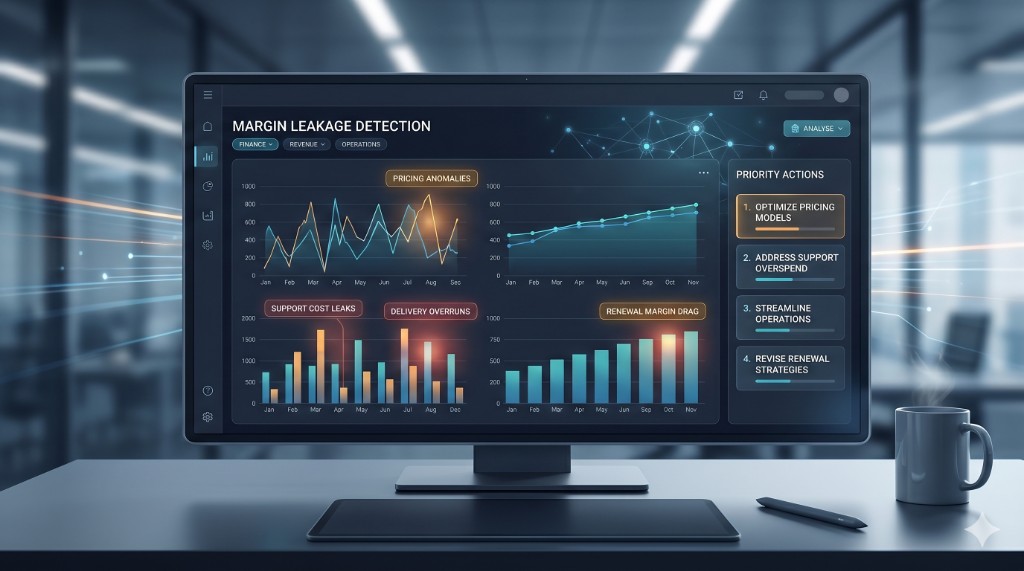
Most growth-stage companies do not lose margin in one big event. They lose it in dozens of small, tolerated leaks.
Discount drift, support over-servicing, implementation overruns, weak renewal guardrails, and hidden delivery inefficiencies quietly accumulate until leadership sees them too late. AI can change this - if it is used as an operating control, not just a reporting layer.
What margin leakage looks like in real companies
Leakage often hides in workflows that appear healthy on the surface:
- Sales discounting increases while win quality does not improve
- Customer onboarding scope creeps beyond contracted economics
- Support load grows faster than ARR in specific segments
- Renewals preserve logo count but erode gross margin
- Manual exceptions bypass pricing and approval standards
Each leak looks small in isolation. Together, they materially weaken EBITDA trajectory.
Why leadership teams miss leakage early
- Metrics are reviewed in silos (sales, delivery, support, finance)
- No shared definition of margin quality by segment
- Reports are monthly, but leakage behavior is daily
- Teams optimize local KPIs that hurt company economics
- There is no explicit owner for cross-functional leakage control
Without a cross-functional signal layer, margin risk is discovered after value is already lost.
The AI margin leakage detection system
Build a weekly operating system with four layers:
- Signal ingestion: collect pricing, discount, effort, support, renewal, and delivery data into one margin-quality view.
- Anomaly detection: identify where actual economics deviate from expected segment benchmarks.
- Impact scoring: rank leaks by annualized gross margin impact and speed of compounding.
- Decision routing: assign owners, deadlines, and escalation logic for closure.
This shifts teams from retrospective explanation to proactive correction.
A 30-minute weekly leadership cadence
- 10 minutes: review top 5 leakage signals by economic impact
- 10 minutes: approve corrective actions (pricing, scope, process, ownership)
- 10 minutes: confirm owners, deadlines, and next checkpoint
Publish a one-page margin action log the same day. If actions are not visible, leakage reappears.
Metrics that prove progress
- Gross margin variance: plan versus actual by segment
- Discount discipline index: policy compliance and exception trend
- Support cost per ARR: trend by customer tier
- Delivery overrun rate: scoped versus actual implementation effort
- Leakage closure velocity: time from signal to verified correction
These indicators show whether you are fixing root causes or only patching symptoms.
Quick answers executives ask
Can we improve margin without hurting growth?
Yes, when fixes target low-quality revenue and avoidable cost patterns instead of broad cuts that weaken demand or customer outcomes.
How fast can this show impact?
Most teams see visibility gains in 2-3 weeks and measurable margin stabilization within one quarter.
Who should own this?
Usually finance and operations jointly, with direct participation from revenue and delivery leaders.
Final thought
Margin leakage is not just a finance issue. It is an operating discipline issue.
Leadership teams that detect leaks early and close them quickly protect both profitability and strategic speed.
One clear email each Thursday
Actionable frameworks on AI execution, agents, and MCP. Join 4,200+ builders.
Leave a comment
Be the first to share your thoughts.