MCP was already winning the integration layer for AI agents. The missing piece for most companies was not another server — it was how you authorize a hundred people without a hundred OAuth flows.
That piece just landed.
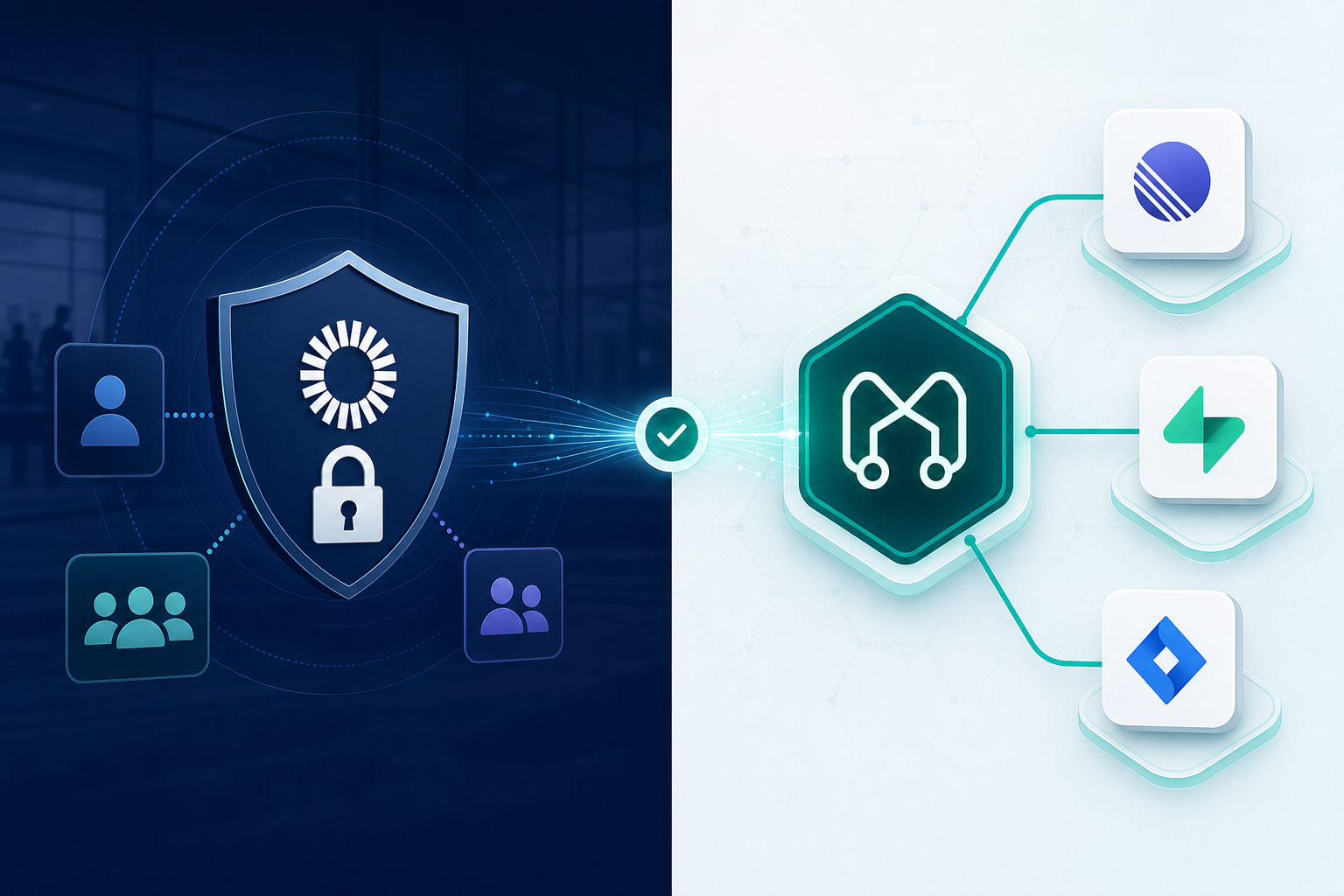
On June 18, 2026, Anthropic announced Enterprise-Managed Authorization for MCP connectors — the first production implementation of an open extension to the Model Context Protocol auth spec. Admins connect Okta (more IdPs coming), provision MCP connectors for the organization once, and users inherit access through the groups and roles they already have.
Connectors show up on first login. No per-tool OAuth parade for every new hire.
This is the moment MCP stops looking like a power-user hack and starts looking like enterprise infrastructure — and it has direct implications for engineering leaders, security teams, and anyone building or listing MCP servers.
The problem enterprise MCP hit in week two
The first MCP pilot in a company usually goes well. One motivated developer wires GitHub, Linear, or Supabase into Claude or Cursor, demos it, leadership gets excited.
Then rollout begins — and friction explodes:
- Admin enables a connector org-wide
- Every employee must individually authorize it
- New hires hit a queue of OAuth screens on day one
- Offboarding relies on long-lived tokens that may outlive the employee
- Security asks whether MCP is “another shadow IT surface” outside the IdP
That is not a protocol failure. It is an authorization UX and governance failure — and it is exactly what blocked MCP from default tooling status at large orgs.
What enterprise-managed auth actually changes
Anthropic’s implementation (beta on Claude Team and Enterprise plans) folds MCP connector access into the same workflow you use for SaaS provisioning:
- Connect your identity provider to Claude (Okta at launch)
- Choose which MCP connectors to enable for the organization
- Scope access by IdP group — same groups you already run
- Users log in once — authorized connectors are already there in Claude chat, Claude Code, and Cowork
For admins, the wins are concrete:
- Provision once, not per user per connector
- Revoke through the IdP — deprovisioned users lose connector access when access should end, not when a token expires months later
- Shorter token lifetimes without killing productivity, because access checks run through the IdP you already trust
- Force IdP-only paths so personal accounts do not get linked to work tools by accident
For end users, the win is simpler: zero-touch setup. Open Claude. The tools you are cleared to use are already connected.
Why this is bigger than a Claude feature
Anthropic is explicit that this builds on an open MCP authorization extension — not a proprietary Claude-only trick. Any MCP provider can implement it; custom internal connectors can support the same pattern.
That matters because enterprise buying decisions are not “which chat UI” alone. They are:
- Does this fit our IdP?
- Can we audit and revoke?
- Will every vendor MCP server we care about support the same model?
Enterprise-managed auth gives security and IT a familiar answer: same plane as the rest of your stack.
Launch partners already on board include Asana, Atlassian (Jira/Confluence/Rovo), Canva, Figma, Granola, Linear, Supabase, and Slack (coming soon) — with customers like HubSpot, Ramp, and Webflow rolling it out across teams.
What it means if you deploy MCP internally
For engineering and platform teams
Your MCP rollout can move from “documented in Notion” to provisioned like any other SaaS integration. Prioritize connectors that support enterprise-managed auth when you standardize on Claude Enterprise — and maintain a short list of approved servers rather than letting every team paste random configs.
Start from servers you already rely on. In the Influzer.ai Top 100 and full directory, compare setup docs and tool lists before you bet production workflows on a connector.
For security and IT
MCP stops being a separate OAuth zoo. Access inherits from Okta groups; revocation is centralized; work vs personal separation can be enforced. That is the difference between “we allow MCP in theory” and “we govern MCP in practice.”
For end users
Less time clicking Authorize. More time using agents that can actually act in Linear, Supabase, Jira, and the rest of your toolchain — if your org enabled those connectors.
Launch connectors worth watching (and where to evaluate them)
These are among the first MCP servers with enterprise-managed auth at launch — each has a detail page on Influzer.ai with tools, transport, and setup context:
- Linear — issues and project workflow from the agent
- Supabase — data and backend without handing everyone a PAT
- Jira / Confluence — Atlassian stack via Rovo MCP
- Asana — work management connectors
- Figma — design ↔ code workflows
Slack support is marked coming soon — watch for it if your agents need messaging in the same governed model.
Search the full catalog when you need niche tools: 1,500+ MCP servers, tool lists re-validated daily.
What MCP server builders should do now
If you maintain a public or internal MCP server, enterprise-managed auth is quickly becoming a checkbox in RFPs and security review — similar to SSO for SaaS a decade ago.
Practical checklist:
- Read the open extension to the MCP authorization spec (Anthropic links implementation details for providers joining the beta)
- Implement IdP-aligned auth — don’t assume every enterprise user will complete standalone OAuth forever
- Document enterprise vs individual setup on your server page and in submission forms
- Submit or update your listing on Influzer.ai so teams comparing governed connectors can find you
Servers that only support “paste your personal API key” will still exist for solo devs — but enterprise adoption will concentrate on servers that plug into IdP-managed rollout.
What this means for MCP directories (including ours)
Discovery is not just “does this server exist?” anymore. Enterprise buyers ask:
- Does it support enterprise-managed authorization?
- Which IdPs?
- Which Claude / client surfaces?
- What tools are exposed — and can we scope them?
At Influzer.ai we aggregate servers from Glama, Smithery, community lists, and manual submissions — with indexed tools and daily validation on live endpoints. As enterprise-managed auth spreads, auth model and IdP support belong in every serious listing, alongside transport and setup steps.
If you ship a governed connector, make sure we have it — and that your entry reflects enterprise setup, not only local dev OAuth.
What has not changed (stay clear-eyed)
- Business logic and validation still yours. Governed auth does not stop agents from calling tools wrong or reasoning badly — see why AI output validation still requires human engineers.
- Beta, Team/Enterprise plans. Not every solo dev gets this on day one; individual OAuth paths remain for many clients.
- Okta first, more IdPs soon. Plan accordingly if you are on Azure AD, Google Workspace, etc.
- Server quality still varies. Enterprise auth on a thin wrapper does not make a bad MCP server good — evaluate tools and behavior.
The game-change in one sentence
MCP won the integration protocol; enterprise-managed auth wins the rollout.
Teams that were stuck between “agents are amazing in demos” and “we can’t deploy this to 500 people” just got a credible path forward. Vendors that implement the extension get pulled into default enterprise stacks. Directories that surface auth and tools help buyers move faster without shadow IT.
Related reading on Influzer.ai
- How to set up your first MCP servers in Cursor — individual dev starter stack
- How we build the aggregated MCP directory — daily updates and submissions
- MCP servers vs REST APIs — why the agent boundary matters
Quick answers
Is this only for Claude?
Launch is on Claude Team/Enterprise with Okta. The extension is an open MCP standard — other clients and IdPs can adopt the same pattern.
Do I need to redo my Cursor MCP config?
Individual Cursor setups are unchanged. Enterprise-managed auth targets org-provisioned Claude deployments first.
Where is the official announcement?
Anthropic: Centrally manage authorization for MCP connectors (June 18, 2026).
We build an MCP server — how do we get on the launch list?
Follow Anthropic’s provider beta for the authorization extension and submit your server to Influzer.ai with enterprise setup notes.
Final thought
The MCP ecosystem spent eighteen months proving agents need tools. The next eighteen months will be about who is allowed to use which tools, through which identity, with what audit trail.
Enterprise-managed auth is the first mature answer — and it will reshape which MCP servers get adopted at scale.
Browse governed-ready connectors in the Top 100. Building one? Get listed. Rolling out to your org? Start with the IdP, not the prompt.
One clear email each Thursday
Actionable frameworks on AI execution, agents, and MCP. Join 4,200+ builders.
Leave a comment
Be the first to share your thoughts.