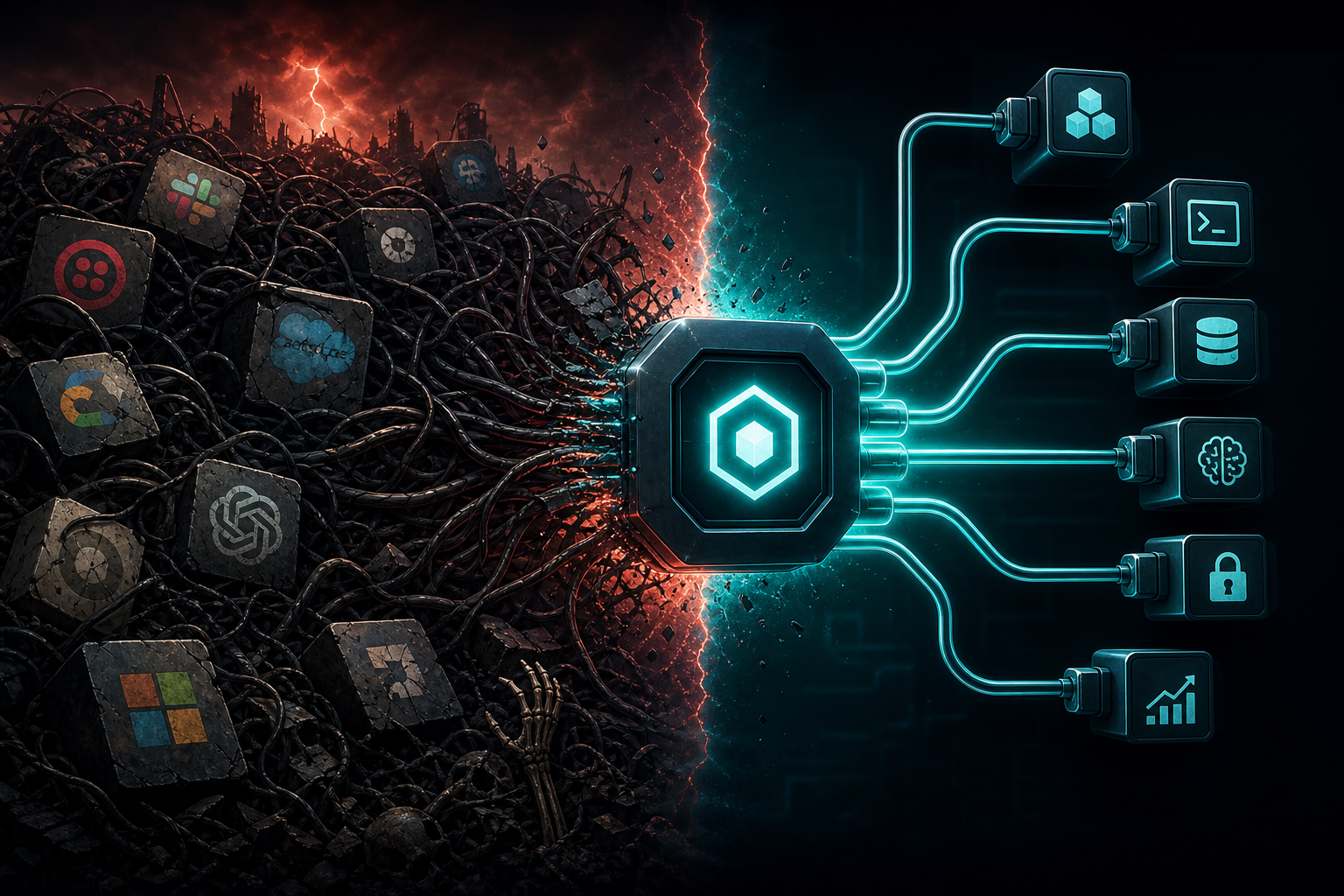
Hot take: your integration backlog is a vanity metric.
Every sprint you spend hand-wiring REST clients into agent workflows is a sprint you are not spending on the thing users actually pay for. And in 2026, the smartest engineering teams have already stopped treating “connect GitHub + Slack + Postgres + browser” as an application problem.
They treat it as a config problem.
Plug in MCP servers. Verify tools/list. Ship.
If that sentence makes you uncomfortable, good — it should. Because the uncomfortable truth is this: MCP servers are becoming the new SDK layer for AI-native software, and most teams are still building like it is 2019.
The integration tax nobody budgets for
Ask any team building with agents what actually slows them down. They will not say “the model is dumb.” They will say:
- “We need another week to wire the ticketing API.”
- “Auth broke when we swapped staging credentials.”
- “The agent keeps calling the wrong endpoint.”
- “We have three different Slack wrappers and nobody knows which one is canonical.”
That is not an AI problem. That is an integration architecture problem — and it is self-inflicted.
For a decade, the default move was: new capability → new SDK → new middleware → new tests → new on-call surprises. That worked when your code was the consumer.
Agents are different consumers. They do not read 200-page API references. They do not “just know” that your Jira wrapper uses different pagination than your Linear wrapper. They need discoverable tools with clear intent — and REST was never designed to give them that at runtime.
MCP was.
Unpopular opinion #1: Your custom integration layer is already legacy code
Sorry. Someone had to say it.
That internal package called integrations-v2-final-really? The one that normalizes errors from six vendors? The one only Priya understands?
It is not a strategic asset. It is debt with good test coverage.
MCP does not delete your business logic. It deletes the repetitive glue — the part every company rebuilds badly, over and over, because there was no standard plug shape for agent capabilities.
Now there is. And the catalog is not theoretical: browse the Top 100 MCP servers and you will find production-ready connectors for GitHub, databases, browsers, docs, cloud providers, and a long tail of niche tools most teams would never justify building in-house.
Every week you extend the old layer instead of adopting the new one, you are investing in code that gets less valuable as the ecosystem matures.
Unpopular opinion #2: “We’ll wrap it ourselves” is often ego, not engineering
Yes, sometimes you need a custom wrapper. Proprietary internal APIs. Weird compliance boundaries. Fine.
But “we’ll wrap GitHub ourselves for the agent” is usually not a technical decision. It is a not-invented-here reflex dressed up as craftsmanship.
The GitHub MCP server exists. So do Playwright, Postgres, Firecrawl, Context7, Slack, and hundreds more. Maintained by vendors or communities who will add tools, fix breakage, and keep up with API drift — while your team ships features.
Your job is not to rebuild the universe. Your job is to compose capabilities into workflows that matter.
That is the shift: from integration builders to integration composers.
What MCP actually changes (in one paragraph for skeptics)
Model Context Protocol gives AI clients a standard way to discover and call tools — named capabilities with descriptions and input schemas — across local processes (stdio) and remote HTTPS endpoints. One protocol. Many servers. Hot-swappable modules.
Your agent does not need to know whether “search issues” comes from GitHub, Linear, or Jira. It needs a tool that does the job. MCP makes that boundary explicit instead of burying it in bespoke client code.
If you want the calmer, side-by-side comparison with REST, read MCP Servers vs REST APIs. This post is the louder version.
The three teams you are competing against
While your backlog fills with integration tickets, three archetypes are pulling ahead:
1. The config-first team
They do not “integrate Slack.” They connect the Slack MCP server in Cursor, verify tools, and move on. New hire? Share the MCP config. Done.
2. The vendor-leverage team
They assume someone already built the server. Search the full MCP directory first; build only when nothing fits. Their agents get new capabilities at the speed of npm install or “paste this URL.”
3. The product team shipping MCP as a surface
SaaS companies are not waiting for you to write wrappers. They are shipping first-party MCP endpoints so agents can use their product out of the box. If you are a vendor without an MCP story, your competitors are already eating your “developer experience” lunch.
Which team sounds like yours?
“But REST still works!” — yes, and that is not the point
Nobody is declaring REST dead. REST is excellent for service-to-service traffic, public product APIs, and deterministic backends.
The point is narrower and sharper: REST is the wrong default boundary for AI agents calling external capabilities.
Forcing an LLM client to navigate your REST surface directly means:
- Endpoint archaeology instead of intent-based tools
- Custom error normalization in every orchestrator
- Prompt fragility when APIs change
- Rebuilt auth flows for every experiment
MCP moves that mess behind a server — often maintained by someone else — and gives your agent a clean tool list to reason about.
Smart architecture in 2026: REST inside your product, MCP at the agent edge.
The SDK graveyard is real
Remember when every SaaS product needed a Ruby gem, a PHP SDK, and a Java client just to be taken seriously? Most of those SDKs rotted. Few teams had the bandwidth to keep them all current.
We are watching the same movie with agent integrations — except the cycle is faster and the consumers are less forgiving.
MCP is the consolidation play. One client protocol in IDEs and assistants. One discovery mechanism. One mental model for “what can this agent do right now?”
Teams still hand-rolling every connector are building the next graveyard. Teams composing MCP servers are building agent stacks that get easier to maintain as the ecosystem grows.
What you should do this week (not “someday”)
You do not need a six-month platform initiative. You need a disciplined experiment:
- Pick one painful workflow — “agent opens tickets from PR comments,” “agent queries staging DB,” “agent scrapes docs for research.”
- Find the MCP server first — search by capability in the Top 100 or full catalog.
- Connect it in your client — Cursor, Claude Desktop, or your own MCP client.
- Run
tools/list— if the tools match your intent, you are 80% done. - Time the alternative — estimate how long a custom REST path would have taken. Feel the rage. Channel it productively.
If the server is missing? Submit it or wrap your internal API as MCP — but define tools, not one-to-one endpoint mirrors.
Provocative predictions (place your bets)
- By end of 2026, “MCP support” will be a checkbox on enterprise RFPs for dev tools — the way “API access” was a decade ago.
- Teams without a shared MCP config will look as behind as teams without CI/CD did in 2015.
- Junior developers will onboard to agent stacks faster than seniors who insist on bespoke REST glue — because the abstraction layer finally matches how agents actually work.
- Vendors without MCP endpoints will lose evals to competitors who ship one first — even if the underlying API is worse.
Call these bold if you want. Then watch the directory grow weekly and tell me which direction feels unlikely.
When you should ignore this post
Fairness matters. Do not pivot to MCP-first if:
- You have no agent use case and no roadmap for one
- You are optimizing a high-QPS microservice path where every millisecond counts
- You are exposing a public API to human developers who expect OpenAPI, not MCP
- Compliance requires a fully custom, audited integration boundary you cannot delegate
This is not religion. It is prioritization. If agents matter to your product, continuing to treat integrations as bespoke app code is the expensive choice.
The question your CTO should ask on Monday
Not “are we using AI?” — everyone is asking that.
Ask: “Are we still building integrations the slow way while our competitors compose MCP servers?”
If the honest answer is yes, you do not have an “AI strategy” problem. You have a integration strategy obsolescence problem.
Quick answers (for the replies section in your head)
Isn’t MCP just hype?
Hype does not get you 1,500+ indexed servers, daily tool validation, and vendors shipping hosted endpoints. Ecosystem depth is the argument.
We tried agents and they failed — why would MCP fix that?
Probably because the agent could not reliably do things. Tooling boundaries matter more than model choice for many workflows.
Security?
Still your job. MCP does not magically scope credentials. It makes the perimeter visible: which servers, which tools, which tokens.
Where do I start?
Top 100 MCP servers. Pick three that match your stack. Connect them this afternoon.
Final thought
You can keep staffing the integration backlog. You can keep rewarding engineers for rebuilding the same wrappers in prettier TypeScript.
Or you can admit the obvious: the agent era needs a different plug shape, and that shape is MCP.
Stop building integrations like it is your moat. Start composing servers like it is your leverage.
The catalog is already here. The teams moving fastest are not smarter — they just stopped doing unnecessary work sooner.
Browse the Top 100 MCP servers, steal a week back from your backlog, and ship something that actually moves the business.
One clear email each Thursday
Actionable frameworks on AI execution, agents, and MCP. Join 4,200+ builders.
Leave a comment
Be the first to share your thoughts.