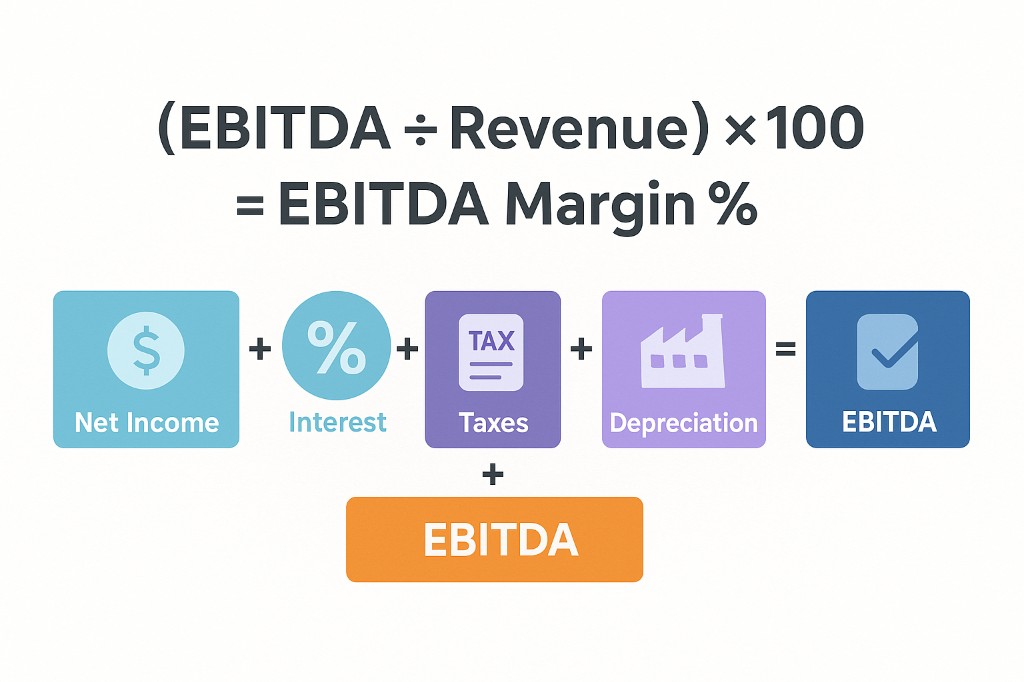
Many leadership teams treat EBITDA and the Rule of 40 as reporting metrics. The strongest teams use them as weekly operating controls.
When used correctly, EBITDA and Rule of 40 force better trade-offs across growth, cost discipline, and execution quality. When used poorly, they trigger blanket cuts that protect short-term margins but weaken long-term value creation.
What EBITDA and Rule of 40 actually tell you
EBITDA shows operating earnings power before financing and accounting structure effects. It is useful for understanding whether the core business model is becoming more efficient.
Rule of 40 combines growth rate and profitability (often EBITDA margin) into one signal of business health:
Growth % + EBITDA margin % = Rule of 40 score
If the score is above 40, the company is generally balancing growth and profitability well. If it is below 40, either growth quality or cost structure usually needs attention.
Where teams go wrong
- They optimize EBITDA in isolation and accidentally kill pipeline quality
- They chase top-line growth with weak contribution economics
- They review the metric monthly, too late to change trajectory
- They treat every cost reduction as equal, instead of protecting high-ROI spend
The result is usually the same: volatility, rework, and leadership confusion about what to prioritize next.
A practical operating model for both metrics
Use a simple weekly rhythm with four blocks:
- Growth quality: pipeline conversion, win quality, retention trend, and expansion efficiency.
- Cost quality: spend by function tied to measurable output, not just budget variance.
- Rule of 40 trajectory: current score, 4-8 week trend, and expected next-quarter range.
- Decision queue: the 3-5 highest-impact decisions that move both margin and growth quality.
This keeps leadership focused on economics, not noise.
How AI improves EBITDA and Rule of 40 decisions
AI is most valuable when it improves decision speed and precision, not dashboard volume. Use it to:
- Detect margin leakage patterns early (discounting, support load, delivery overrun)
- Identify growth channels with strong payback versus vanity volume
- Forecast how specific decisions impact both EBITDA margin and growth rate
- Prioritize trade-offs by economic consequence, not political urgency
That changes the conversation from "where can we cut" to "where should we reallocate for the best Rule of 40 outcome."
Metrics to track each week
- EBITDA margin trend: week-over-week direction and variance drivers
- Growth quality index: net new ARR quality, retention-adjusted growth, and sales efficiency
- Rule of 40 run-rate: current and projected score
- Decision latency: time from signal to executive decision
These indicators reveal whether your operating model is improving or just your reporting narrative.
Quick answers executives ask
Should we prioritize EBITDA first in this market?
Prioritize resilience, not a single metric. In most cases, the right move is improving EBITDA while protecting high-quality growth inputs.
What if our Rule of 40 is below 40 today?
Use it as a directional signal, not a panic trigger. Tighten decision cadence, remove low-ROI spend, and improve growth quality before applying broad cuts.
How fast can this approach show results?
Most teams see early visibility improvements in 2-4 weeks and clearer margin-growth trade-offs within one quarter.
Final thought
EBITDA and the Rule of 40 are not finance-only KPIs. They are leadership discipline tests.
The teams that win are not the ones that cut fastest or grow fastest in isolation. They are the ones that repeatedly make high-quality decisions that improve both economics and momentum.
One clear email each Thursday
Actionable frameworks on AI execution, agents, and MCP. Join 4,200+ builders.
Leave a comment
Be the first to share your thoughts.